Why is slipform paving better than precast concrete? The answer begins with how each method behaves on a real construction site. Slipform paving places fresh concrete continuously, while a self-propelled paver forms the slab without fixed molds. This process creates long, consistent pavement sections with fewer joints. Fewer joints can mean fewer weak points, less water intrusion, and smoother vehicle movement.
It is a practical difference.
Peter C. Taylor, a respected concrete pavement engineer, has emphasized, “Concrete pavement is a system, not just a slab.” That perspective matters here. Slipform paving connects mix design, paving speed, vibration, curing, alignment, and quality control. Experienced crews can adjust the operation when weather, traffic, or material conditions change. Precast panels offer factory-controlled production, but transportation, lifting, bedding, and joint alignment introduce additional steps. Every step creates another opportunity for delay or error.
The comparison is not completely one-sided. Precast concrete can be valuable where rapid opening, limited access, or nighttime repair work controls the project. Slipform paving needs enough space for equipment and a steady concrete supply. Poor planning can still produce roughness, segregation, or curing problems. That limitation deserves attention.
For large roads, airport pavements, industrial yards, and continuous concrete lanes, slipform paving often offers stronger production efficiency and better surface continuity. Its advantages become clearer when contractors monitor line, grade, thickness, air content, slump, and curing—not just appearance. The right choice depends on project scale, access, schedule, and local expertise.
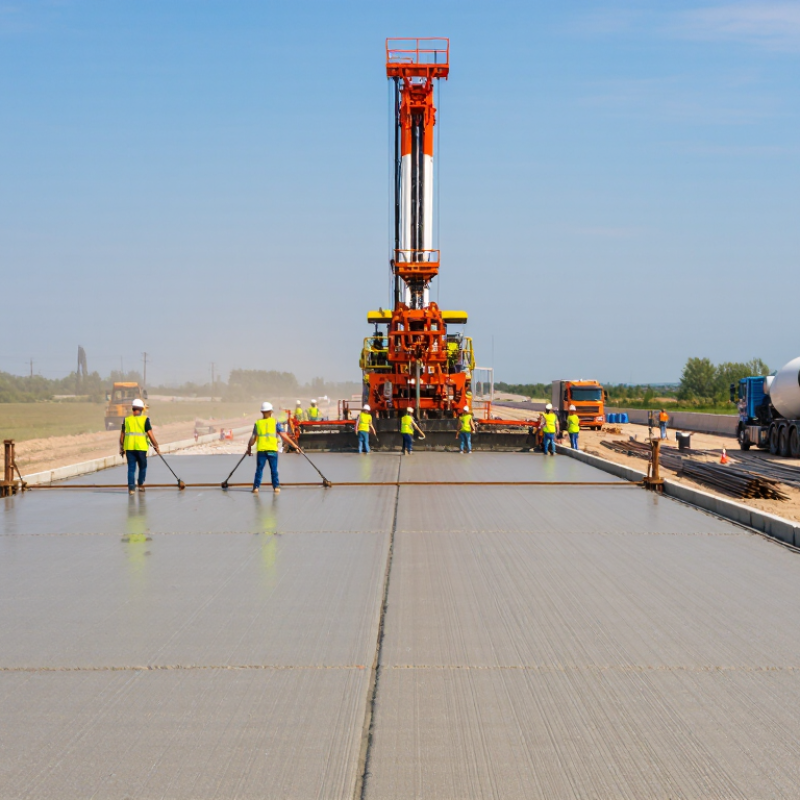
Slipform paving places fresh concrete directly on the prepared roadbed. A paver continuously spreads, vibrates, and shapes the slab without fixed side forms. Precast concrete means factory-made panels, cured before delivery, then transported and lifted into position. The difference is simple: one method builds continuously on site, while the other assembles finished pieces.
Slipform paving often suits long, uninterrupted road sections. It reduces panel joints, lifting operations, and truck movements. The Federal Highway Administration reports that continuous paving can improve production consistency when mix supply and site logistics remain stable. Surface texture is also created immediately behind the machine. It feels precise, almost mechanical.
Precast panels offer a different advantage. NCHRP Report 848 notes that precast pavement systems can shorten lane closures, especially during night repairs. Some projects can reopen traffic within 24 hours, when design, curing, and installation conditions cooperate. However, joints require careful alignment and sealing. A poorly fitted panel can create noise, impact, and premature distress. Slipform paving is not always better. Tight urban sites, interrupted work zones, or urgent repairs may favor precast concrete. The real decision depends on traffic control, haul distance, weather, crew experience, and concrete supply. That part is easy to underestimate.
Why Is Slipform Paving Better Than Precast Concrete?
How Slipform Paving and Precast Concrete Are Installed
Slipform paving starts with a compacted base, stringline control, and fresh concrete delivered continuously. A paver spreads, vibrates, and shapes the mix without fixed side forms. Sensors adjust elevation as the machine moves. On suitable projects, the American Concrete Pavement Association reports production rates of roughly 300 to 600 linear feet per hour. Crews then cut contraction joints, apply curing compound, and protect the surface from early moisture loss. The result is a continuous pavement with fewer lifting operations. Fast placement matters.
Precast concrete follows a different path. Panels are cast and cured in a controlled plant, then transported to the site. Crews prepare the foundation, lift each panel into position, adjust bedding, and seal or connect the joints. The Precast/Prestressed Concrete Institute’s MNL-116 emphasizes factory testing, dimensional control, and verified concrete strength. Many highway panels specify strengths near 5,000 psi or higher. This process can shorten road closures, especially where night work is required. However, trucks, cranes, storage space, and tight joint tolerances add coordination risks. Slipform paving is often more efficient for long, open alignments. It is not automatically better. Poor mix control, weak subgrade preparation, or interrupted deliveries can quickly damage its productivity. A careful site review should come before choosing either method.
Slipform paving often wins on construction speed because it turns concrete placement into a continuous operation. The paving machine receives concrete, spreads it, vibrates it, and forms the slab in one pass. There are no precast panels waiting for delivery or crane lifting. The process feels almost industrial.
The Federal Highway Administration’s Concrete Pavement Construction TechBrief reports that slipform paving can exceed 500 linear feet per hour under favorable conditions. Actual output depends on concrete supply, weather, crew experience, and site access. A short interruption can still create a long delay. That weakness is easy to underestimate.
Precast concrete can shorten field work, especially where traffic must reopen quickly. However, production moves elsewhere. Panels require factory casting, curing, transport planning, lifting equipment, and accurate placement. The FHWA Accelerated Bridge Construction Manual identifies off-site fabrication as a major schedule advantage, but also highlights delivery and coordination risks. Slipform paving usually needs less lifting and fewer site movements. The National Concrete Pavement Technology Center also emphasizes continuous material supply and stable paving conditions as key productivity factors. In practical work, a well-organized slipform crew may advance steadily across a long roadway, while precast installation may pause between trucks, joints, and measurements. Not always. Tight urban sites can reverse the result. A fair comparison must measure total duration, including fabrication, transport, curing, setup, and traffic control.
General comparison of continuous slipform paving and precast concrete installation for large-scale pavement and linear infrastructure projects.
| Construction Dimension | Slipform Paving | Precast Concrete | Site-Efficiency Implication |
|---|---|---|---|
| Basic Construction Method | Continuous placement Fresh concrete is placed, shaped, consolidated and finished in a continuous operation using a paving machine. |
Segmental installation Factory- or yard-produced units are transported to the site, positioned and connected or jointed. |
Slipform paving reduces the number of separate placement and handling steps on the active work front. |
| Typical Production Pattern | Designed for repetitive, linear work with a continuously moving paving train. Actual output depends on slab thickness, paving width, concrete supply and site conditions. | Installation proceeds unit by unit, with progress governed by delivery sequence, lifting capacity, alignment and joint treatment. | Continuous production generally provides a smoother workflow on long, uninterrupted pavement sections. |
| Construction Speed | Potentially faster for long runs Large paving machines can place substantial lengths in a working shift when concrete supply and logistics remain consistent. |
Fast placement in suitable layouts Individual units can be installed quickly, but overall progress may slow when many pieces, joints or lifting operations are required. |
Slipform paving is usually more efficient for highways, airfield pavements and other large areas with consistent geometry. |
| Material Handling | Concrete is delivered directly to the paver by dump trucks, agitator trucks or other approved transport systems. | Each unit must be cast, cured, stored, loaded, transported, unloaded and lifted into its final position. | Slipform paving can reduce double handling, storage requirements and the number of lifting operations at the site. |
| Transportation Requirements | Requires a reliable supply of fresh concrete and coordinated aggregate, cementitious-material and admixture deliveries. | Requires transport capacity for finished units, often including route planning, loading controls and lifting equipment at the installation area. | Precast logistics can be more sensitive to delivery timing, traffic restrictions, unit dimensions and site access. |
| Joints and Connections | Longitudinal and transverse joints are formed or sawn according to the pavement design and construction specifications. | Every interface between units requires accurate positioning and appropriate joint, connection, sealant or grout treatment. | Fewer construction interfaces can simplify quality control and reduce installation-related alignment work. |
| Equipment and Labor | Needs specialized paving equipment, trained operators, concrete testing personnel and a coordinated finishing and curing crew. | Needs lifting equipment, transport vehicles, rigging personnel, installation crews and workers for joint or connection treatment. | Slipform paving concentrates resources in a continuous paving operation, while precast installation distributes effort across handling and assembly tasks. |
| Formwork Requirements | Uses the paving machine to shape and support the slab, reducing the need for conventional fixed side forms on many projects. | Units are manufactured in molds or forms before delivery; site installation typically requires prepared bearing or support surfaces. | Reduced site formwork can shorten preparation time, particularly for repetitive pavement widths. |
| Quality Consistency | Quality depends on continuous control of concrete workability, paving speed, vibration, slab thickness, finishing and curing. | Factory production can provide controlled casting conditions, while transportation and site handling introduce additional risks of damage or dimensional variation. | Precast offers strong factory-control potential; slipform offers efficient in-place production when process control is well managed. |
| Site Space Requirements | Primarily requires a clear paving lane, concrete delivery access and space for support operations. | May require temporary storage, staging areas, crane operating zones and unobstructed delivery routes. | Slipform paving can reduce congestion on constrained sites where storage and lifting areas are limited. |
| Weather and Supply Sensitivity | Fresh-concrete paving is sensitive to temperature, precipitation, wind, evaporation and interruptions in concrete delivery. | Finished units are less dependent on fresh-concrete placement conditions during installation, although lifting, bedding and joint materials remain weather-sensitive. | Precast can provide scheduling flexibility in some weather conditions, while slipform requires disciplined concrete-supply planning. |
| Design Flexibility | Well suited to long, repetitive alignments and standard cross-sections; changes in geometry may require careful machine and process adjustments. | Useful for modular layouts and areas requiring removable, replaceable or highly controlled individual components. | The better method depends on whether the project prioritizes continuous production or modular replacement and access. |
| Best-Fit Applications | Large continuous surfaces Highways, airport pavements, industrial yards, ports and other projects with long runs and repeated slab geometry. |
Modular or access-sensitive work Utility covers, bridge components, drainage structures, repairs, confined areas and projects requiring factory-produced units. |
Project geometry, access, production volume and required installation sequence should determine the selection. |
| Overall Site Efficiency | High for large linear projects Continuous placement can reduce handling, minimize work-front interruptions and support rapid area coverage. |
High when modularity is valuable Factory production and rapid individual placement can be advantageous where repeatability, replacement or restricted on-site concrete work is important. |
Slipform paving is generally the more site-efficient option for large, uninterrupted pavement areas, but precast remains preferable for modular, restricted-access or highly specialized applications. |
Note: Actual construction rates, labor requirements and total project duration vary with pavement dimensions, concrete mix, weather, curing requirements, site access, equipment availability, inspection procedures and local specifications. The comparisons above describe common industry practice rather than guaranteed project performance.
Why Is Slipform Paving Better Than Precast Concrete?
Comparing Quality, Durability, and Structural Performance
Slipform paving creates a continuous concrete surface directly on the prepared subgrade. The paver places, vibrates, and shapes the concrete in one controlled movement. This reduces handling damage and limits joints across long pavement sections. Fewer joints can mean smoother travel and fewer weak points for water entry. On active sites, crews can inspect edge profiles, surface texture, and alignment as work progresses. That feedback supports consistent quality, but testing remains essential.
Precast concrete is produced in factory conditions, where mix proportions, curing temperatures, and dimensions can be checked repeatedly. Its quality may be more predictable before delivery. However, transport and lifting can cause chips, cracks, or dimensional problems. Field connections also influence structural performance. A well-designed joint can transfer loads effectively. A poor connection may cause rocking, leakage, or uneven settlement. Slipform paving avoids many connection details, improving load distribution across a continuous slab. Its performance still depends on subgrade preparation, concrete workability, machine calibration, and curing protection.
Durability is not automatic. Freeze-thaw cycles, deicing salts, heavy wheel loads, and poor drainage can damage either system. Field practice suggests that slipforming suits long, repetitive pavements with steady concrete supply. Precast can help where construction windows are short or replacement must occur in sections. The comparison is not entirely fair without lifecycle data. Initial speed may hide future joint repairs, while continuous paving demands stricter weather control. Small surface defects deserve attention. They often reveal larger process weaknesses.
Comparing quality, durability, and structural performance
The five-point scale summarizes commonly documented engineering characteristics of continuous slipform paving and precast concrete pavement systems. Slipform paving generally reduces transverse joints and enables continuous load transfer, while precast concrete provides factory-controlled production and rapid installation. Actual performance depends on pavement design, materials, drainage, curing, foundation support, joint details, and construction quality.
Slipform paving uses machine-extruded concrete instead of precast units. It is practical when a project needs long, continuous pavement with fewer joints. Crews place concrete directly along the prepared alignment. The machine then shapes and supports the slab. This reduces lifting, storage, and repeated unit placement. On a large roadway, that can simplify traffic planning and handling. The result depends heavily on mix consistency and accurate grade control.
Slipform paving works best where access is open and the pavement geometry is fairly continuous. A steady concrete supply matters. If trucks arrive irregularly, the paving train may stop. This can leave visible marks or weak interfaces. Experienced supervisors monitor slump, temperature, line, level, and edge support throughout the pour. Small moisture changes can affect surface quality more than expected. Weather can also disrupt a practical plan.
Precast concrete remains useful for restricted sites, rapid replacement, or factory-controlled units. Slipform paving is less convenient around covers, tight corners, short sections, and frequent design changes. It also requires trained operators and reliable site coordination. In practice, the choice should follow the site, not personal preference. A continuous road may reward slipforming, while a fragmented repair may not. That distinction is easy to overlook.
Crews compact the base and set stringline controls. Fresh concrete arrives continuously. A paving machine spreads, vibrates, and shapes the slab without fixed side forms. Sensors adjust elevation as the machine advances. Workers cut contraction joints and apply curing compound.
Panels are cast and cured in a controlled plant. At the site, crews prepare the foundation and bedding. Cranes lift each panel into position. Workers adjust alignment, then seal or connect the joints. Accuracy matters.
Slipform paving is often faster on long, open roadways. Suitable projects may reach about 300 to 600 linear feet per hour. Continuous placement avoids repeated lifting operations. Still, interrupted concrete deliveries can quickly reduce productivity.
Precast concrete can shorten field work and road closures. This helps when traffic must reopen quickly, including some night projects. Factory production happens away from the roadway. Transport delays, crane access, and storage needs can weaken that advantage.
Slipform paving uses fewer lifting operations and fewer site movements. Precast installation requires trucks, cranes, storage areas, and careful measurements. Urban restrictions may favor precast panels. A simple answer would be misleading.
The project needs a stable subgrade, reliable concrete supply, and suitable weather. Experienced crews also maintain steady machine movement. Sensors depend on accurate control lines. Weak preparation can damage productivity before paving begins.
Factory testing helps verify strength and dimensions. Many panels use concrete strengths near 5,000 psi or higher. Crews must check bedding, panel position, and joint tolerances. Small measurement errors can create larger installation problems.
No method is automatically better. Slipform paving often suits long, accessible alignments. Precast concrete may suit restricted sites or urgent traffic reopening. The comparison should include fabrication, transport, setup, curing, placement, and traffic control. That broader view is often missed.
Slipform paving and precast concrete are two different approaches to creating durable concrete structures. Slipform paving places and shapes fresh concrete continuously on site using a moving form, while precast concrete is produced in separate molds, cured in advance, and transported for installation. Their installation methods influence project planning, labor requirements, transportation needs, and the ability to adapt to changing site conditions.
When comparing construction speed and site efficiency, slipform paving can provide a continuous workflow with fewer joints, less handling, and reduced reliance on transporting large components. It can also create consistent alignment and strong integration with the surrounding pavement. Precast concrete may offer controlled factory production and predictable components, but delivery, lifting, storage, and joint assembly can add complexity. In terms of quality, durability, and structural performance, both methods can be effective when properly designed and installed. Overall, why is slipform paving better than precast concrete? It is often the more practical choice for long, continuous pavement projects where speed, seamless construction, adaptability, and efficient on-site production are priorities.

MRECH Machinery