2026 Best Concrete Mix Ratio for Slipform Paving?

Time:2026-11-10 Author:Isabella
0%

Slipform paving leaves little room for a mix that slumps, tears, or dries unevenly. The concrete must hold its shape behind the machine while remaining workable enough to consolidate around the paving equipment. So, what is the best concrete mix ratio for slipform paving? There is no single ratio that suits every project. Cement type, aggregate grading, moisture, weather, pavement thickness, and machine speed all affect the result.

A reliable starting point comes from the project specifications and trial batches, not a copied recipe. Contractors typically control water carefully, since excess water can weaken the finished pavement and encourage edge slump. The mix also needs enough cohesion to keep coarse aggregate evenly distributed as the paver moves. Watch the concrete at the machine: clean edges, a stable surface, and consistent consolidation are useful field clues. Small changes in aggregate moisture can shift the effective water content. Easy to miss.

This guide explains how mix proportions, slump, air content, and testing work together in slipform paving. It also considers why a mix that performs well in one plant may need adjustment at another. Laboratory results matter, but so does observing fresh concrete under actual paving conditions. A trial section can reveal problems before they repeat across a long pavement run. Even then, field observations should be checked against approved specifications and test data. The right mix is the one that meets strength and durability requirements while feeding and finishing consistently. That balance takes measurement, judgment, and occasional correction.
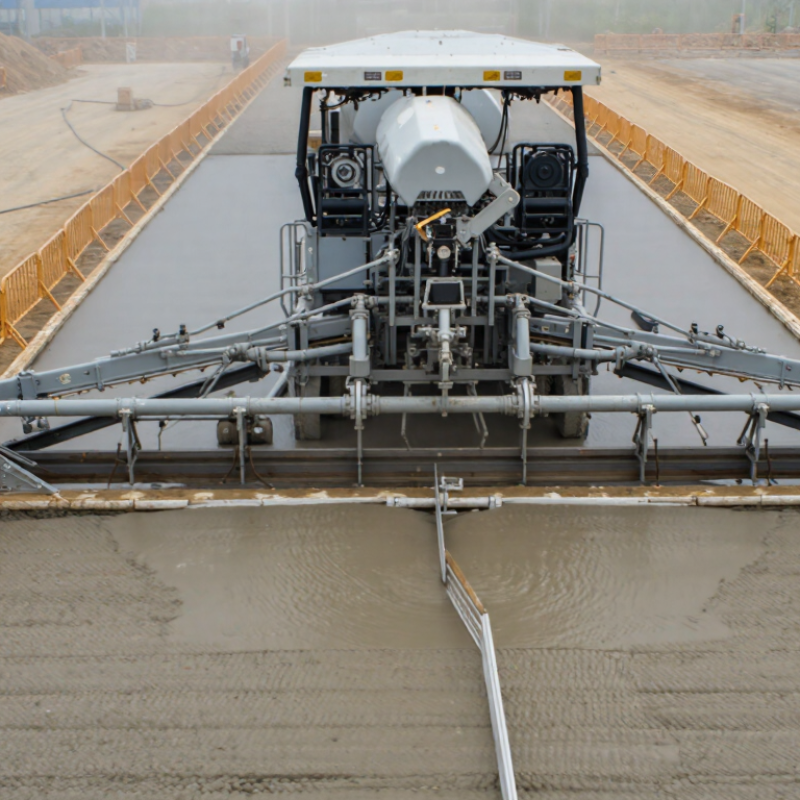
2026 Best Concrete Mix Ratio for Slipform Paving?

Key Performance Requirements for Concrete Used in Slipform Paving

Slipform paving needs concrete that holds its shape as the forms move, yet still flows around vibration. A fixed mix ratio cannot suit every project. Aggregate shape, moisture, haul time, and weather all change how a batch behaves. The fresh mix should have low, consistent slump, good cohesion, and minimal segregation. Too wet, and slab edges may slump. Too stiff, and consolidation can leave honeycombing behind.

Hardened concrete must meet specified strength and durability requirements, including resistance to freeze-thaw cycles where relevant. Well-graded aggregates help reduce paste demand and improve consistency. Air content also matters in exposure conditions that require freeze-thaw protection. Check it at the paving site, not only at the plant. One detail is easy to underestimate: small moisture changes in stockpiles can shift the effective water-cementitious ratio. Even a sound design may then pave poorly. Trial batches and field adjustments should follow the project specification and documented test results.

Tips: Watch the first few metres closely. Check edge stability, surface texture, and how the mix responds to vibration. Record slump, air, concrete temperature, and batch time. If the finish looks rough, adding water may seem tempting, but it can weaken performance. Pause, verify the cause, and adjust only through an approved procedure.

Core Materials and Their Roles in the Mix

Concrete for slipform paving must hold its shape as the paver moves, yet remain workable enough to consolidate around reinforcement. Cementitious materials bind the mix; Portland cement provides early strength, while supplementary materials can improve durability and reduce heat. Their proportions depend on local materials and project requirements. More cement is not automatically better. Too much can increase shrinkage and cracking.

Aggregates make up most of the concrete’s volume. Well-graded sand and stone pack together efficiently, helping limit paste demand and support a dense surface. Consistent aggregate moisture matters: a wet stockpile can quietly add water and soften the mix. Water enables placement and hydration, but excess water can weaken hardened concrete and promote slab-edge slump. Keep it controlled. Small changes count.

Admixtures help fine-tune the mix. Water reducers can improve workability without adding water, while air-entraining agents create tiny bubbles that help concrete resist freeze-thaw damage. Fibers may reduce plastic shrinkage cracking, though they do not replace properly designed reinforcement. There is no universal best ratio. Trial batches should use the actual aggregates, cementitious materials, and paving equipment, then be checked for slump, air content, finish, and edge stability. Field adjustments are sometimes necessary; they should be measured and recorded, not guessed.

Selecting Mix Proportions for Strength, Workability, and Edge Stability

The best concrete mix ratio for slipform paving is the one that meets strength requirements while holding a clean edge after the machine passes. A fixed recipe rarely transfers well between projects. Cement content, aggregate shape, moisture, and weather all change how the mix behaves.

Set proportions by weight, then verify them with trial batches and the project specifications. A water-to-cementitious-material ratio around 0.38 to 0.45 may be a starting range, not a guarantee. Too much water can cause edge slump and reduce strength. Too little can leave dry pockets behind the paver. That balance is unforgiving. Check aggregate moisture each shift, since a wet stockpile can quietly raise the effective water content.

For workability, judge the mix at the placement point, not just in the batch ticket. It should consolidate around dowels and reinforcement without flowing out of shape. Watch the slab edge after the paver moves forward; a slight bulge or tearing can signal poor grading, excess water, or insufficient paste. Small changes matter. Adjust one variable at a time, then record the result. A batch that looked stable in cool morning conditions may behave differently under midday heat. Trial results are useful, but field observations still deserve careful review.

2026 Best Concrete Mix Ratio for Slipform Paving? — Selecting Mix Proportions for Strength, Workability, and Edge Stability
Mix parameter Practical starting range Why it matters for slipform paving
Water-to-cementitious materials ratio (w/cm) About 0.38–0.45 by mass; use the project specification’s maximum where one is set. A controlled, relatively low w/cm can support strength and durability. Too much water can make the fresh concrete less able to hold a stable vertical edge.
Total cementitious materials Approximately 300–380 kg/m³ (505–640 lb/yd³), adjusted for materials, exposure, and specified performance. Provides paste for coating and cohesion. Excessive content can increase heat, shrinkage, and cost without necessarily improving paving performance.
Water content Common trial-batch range: about 135–165 kg/m³ (228–278 lb/yd³), including moisture corrections as required. Use only enough water to achieve consistent placement and finishing. Aggregate moisture and admixture effects should be included in batch adjustments.
Fine aggregate Often about 650–850 kg/m³ (1,095–1,430 lb/yd³); determine the final amount by absolute-volume mix design. Well-graded sand helps maintain cohesion and surface finish. Too little may encourage harshness; too much can increase water demand and reduce coarse-aggregate interlock.
Coarse aggregate Often about 1,000–1,200 kg/m³ (1,685–2,020 lb/yd³); select nominal maximum size to suit slab thickness, reinforcement, and placement equipment. Sound, consistently graded aggregate contributes to strength and dimensional stability. Verify that the grading feeds and compacts reliably through the paving equipment.
Approximate mass ratio A preliminary trial proportion may fall near 1 : 1.8–2.4 : 2.8–3.6 (cementitious materials : fine aggregate : coarse aggregate), with w/cm established separately. This is a screening guide, not a prescription. Actual proportions depend on aggregate specific gravity, absorption, grading, air content, and required yield.
Fresh-concrete consistency Many slipform paving mixtures use a low slump, commonly around 0–50 mm (0–2 in), subject to equipment and project requirements. The mix must be workable enough to consolidate while remaining cohesive enough to retain its shape behind the slipform. Confirm consistency through a paving trial.
Air content Set by exposure requirements and the applicable specification; freeze-thaw paving mixes commonly require intentionally entrained air, often in the approximate 4–7% range. Air entrainment can improve resistance to freezing and thawing. The target depends on exposure, aggregate size, and specified test method; excessive air can reduce strength.
28-day strength target Use the specified strength criterion. Pavement designs commonly specify flexural strength, compressive strength, or both; values must match the design and test method. Strength is a performance requirement, not a fixed mix ratio. Confirm it with trial batches and the specified age and test procedure.
Edge stability and trial paving Assess fresh edge support, surface finish, consolidation, and consistency during a full-scale or representative paving trial. There is no single proportion that guarantees edge stability. Adjust grading, paste volume, water, air, and admixture dosage based on observed results and documented testing.

Note: These are general starting ranges for mix development, not a project-ready prescription. Final proportions should be established by an approved mix design, trial batches, applicable standards, exposure conditions, and project specifications.

Adjusting the Mix for Weather, Equipment, and Project Conditions

2026 Best Concrete Mix Ratio for Slipform Paving?
Adjusting the Mix for Weather, Equipment, and Project Conditions

There is no reliable universal mix ratio for slipform paving. The mix must hold the pavement edge after the machine passes, while remaining workable enough to consolidate around reinforcement and dowels. Start with a trial mixture, then verify slump, air content, strength, and edge stability using the project specifications. Small changes matter. A wet aggregate stockpile can quietly add water and weaken consistency.

Weather changes the adjustment. ACI 305R-20 flags evaporation rates near 0.2 lb/ft² per hour as a level where precautions against plastic-shrinkage cracking are warranted. In hot, dry, or windy conditions, shade materials, manage delivery times, and protect fresh pavement; do not simply add water at the paver. ACI 306R-16 treats conditions below, or expected below, 40°F as cold-weather concreting, calling for suitable temperature control and protection. Check the actual mix temperature, not just the forecast.

Equipment and haul distance matter, too. A faster paving speed or longer delivery delay can expose inconsistencies in aggregate grading, moisture correction, and admixture timing. Record batch moisture, concrete temperature, slump, and paving behavior across each shift. Adjust one variable at a time. It is tempting to chase a perfect number, but field conditions rarely stay perfect; even a well-designed trial mix needs reassessment when the wind rises or the machine pauses.

2026 Best Concrete Mix Ratio for Slipform Paving? Adjusting for Weather, Equipment, and Project Conditions

Illustrative trial mix quantities per cubic meter—not a universal specification.

This example uses 360 kg of cementitious material and 144 L of water, giving a water-to-cementitious-material ratio of 0.40. Adjust batch water for aggregate moisture and verify the mix with trial batches. In hot or windy conditions, manage slump loss with approved practices and admixtures rather than adding unaccounted water. Confirm final proportions, air content, and workability against project specifications and paving-equipment requirements.

Field Testing, Placement, and Curing for Consistent Pavement Quality

2026 Best Concrete Mix Ratio for Slipform Paving?

For slipform paving, the best mix ratio is the one that holds its shape while moving smoothly through the machine. Start with the project specifications, then adjust the trial mix for aggregate grading, cementitious materials, and site conditions. A fixed water-to-cementitious-materials ratio cannot suit every job. Keep water controlled; adding water at the paver can weaken the finished surface. Small changes matter. Check slump, air content, temperature, and unit weight at the site, not just at the plant. Record each result beside the batch and paving location.

During placement, watch the slab edges and surface behind the mold. The concrete should stay firm without tearing, dragging, or slumping. If the edge leans, check consistency, vibration, and paving speed before changing the whole mix. Use standard test methods and trained personnel, and compare results with the approved mix requirements. Field readings can vary, so one test should not drive a major adjustment. I have seen crews focus on slump and miss a change in aggregate moisture.

Tips: Keep a simple batch log. Note rain, wind, and delays. Apply the specified curing method as soon as finishing allows, and protect the surface from rapid moisture loss. Watch the edges. If curing starts late, document it and review the surface later; the schedule may look fine while early drying leaves marks.

FAQS

Is there one ideal mix ratio for slipform paving?

No. The right proportions depend on local materials, project needs, and paving equipment. Trial batches help verify performance.

Why shouldn’t a mix contain too much cement?

Extra cement does not guarantee better pavement. It can increase shrinkage and cracking. More is not always better.

How can aggregate moisture affect the mix?

Wet sand or stone can add unplanned water. Check stockpile moisture and adjust batch water to keep consistency.

What should the mix do after the paver passes?

It should hold a stable edge while remaining workable around reinforcement and dowels. A useful check is the fresh slab’s edge.

Can admixtures improve workability or durability?

Water reducers can improve workability without extra water. Air-entraining agents create tiny bubbles that help resist freeze-thaw damage. Fibers may reduce plastic shrinkage cracks, but they do not replace designed reinforcement.

What should a trial batch be checked for?

Check slump, air content, strength, surface finish, and edge stability. Use the actual materials and paving equipment. Record results.

What changes in hot, dry, or windy weather?

These conditions can increase evaporation and plastic-shrinkage risk. Shade materials, manage delivery times, and protect fresh pavement. Don’t simply add water at the paver.

How should cold-weather paving be managed?

When temperatures are below, or expected below, 40°F, use suitable temperature control and protection. Check the concrete temperature, not only the forecast.

How can paving speed and delivery delays affect consistency?

Faster paving or longer hauls can expose changes in aggregate moisture, grading, and admixture timing. Record conditions each shift and adjust one variable at a time. I’d still reassess the mix when the wind rises or the machine pauses.

Conclusion

The best concrete mix for slipform paving is not a fixed recipe; it is a balanced design that meets strength and durability requirements while remaining workable enough to place continuously. This summary explores what is the best concrete mix ratio for slipform paving by considering the roles of cementitious materials, aggregates, water, and admixtures. Proportions should support a consistent, cohesive mix that can pass through paving equipment and retain stable pavement edges immediately after placement.

Weather, aggregate moisture, equipment settings, and project conditions can all affect performance, so mix adjustments should be based on testing rather than guesswork. Field checks for consistency, strength, and air content help confirm that the concrete meets project needs. Careful placement, timely finishing, and effective curing further reduce the risk of surface defects and uneven performance, helping produce uniform, durable pavement.

Isabella

Isabella

Isabella is a dedicated marketing professional with a sharp focus on driving brand growth and engagement through strategic content creation. With an extensive background in digital marketing, she combines her passion for storytelling with her keen understanding of industry trends to deliver......